
How Ontario Arrests Become Records
The Ontario Police Department builds its own arrest packet for every arrest its officers make. A records-management entry goes with it. What the department does not publish is a daily public Ontario arrest log. Custody works differently. Once a person enters the San Bernardino County Sheriff's detention system, a separate booking and custody entry can appear. It can show up in the Sheriff Inmate Locator. The city record tracks the Ontario police event itself. The county record tracks custody status, a projected release date, or a dated out-of-custody result. Ontario counted an estimated 180,224 residents on January 1, 2024. The figure comes from the county budget table. That size still doesn't turn press releases into a complete blotter. Arrests made by the Sheriff, by other departments, or by state or federal officers follow the system of the agency involved. So start with whatever agency appears on the citation, release paper, or case document.
Where Ontario Recent Arrests Appear
No single screen brings together every Ontario arrest, custody change, police report, and court result. The city's channels are built on records access. A daily public log simply is not one of them. Each request has to go to the office that holds the record.
| Channel | What it covers | Photos | Access |
|---|---|---|---|
| Ontario Records and GovQA | City-held police reports and arrest packets, subject to release rules | Investigation photos may be requested | Counter or online request |
| Sheriff Inmate Locator | Current county custody, projected releases, and dated out-of-custody entries | No public photo field observed | Name or 10-digit booking number |
| Ontario press releases | Selected incidents, not a complete arrest list | Only when the agency chooses to publish | Official city news channel |
| Superior Court portal | Case activity and disposition after filing | Not a mugshot source | Online case search |
The Sheriff generally does not release booking photos. That is a publication policy, nothing more. It does not mean no intake photograph was ever taken. Unofficial reposts of Ontario mugshots can be stale or cut loose from the court outcome, so treat them as tips rather than records.
Ontario Has No Public Daily Arrest Log
Ontario publishes no official daily arrest blotter. The official Ontario Police Department page offers department information, but it is not a running list of arrests. News coverage and press releases pick and choose events. Neither can stand in for a real arrest log.
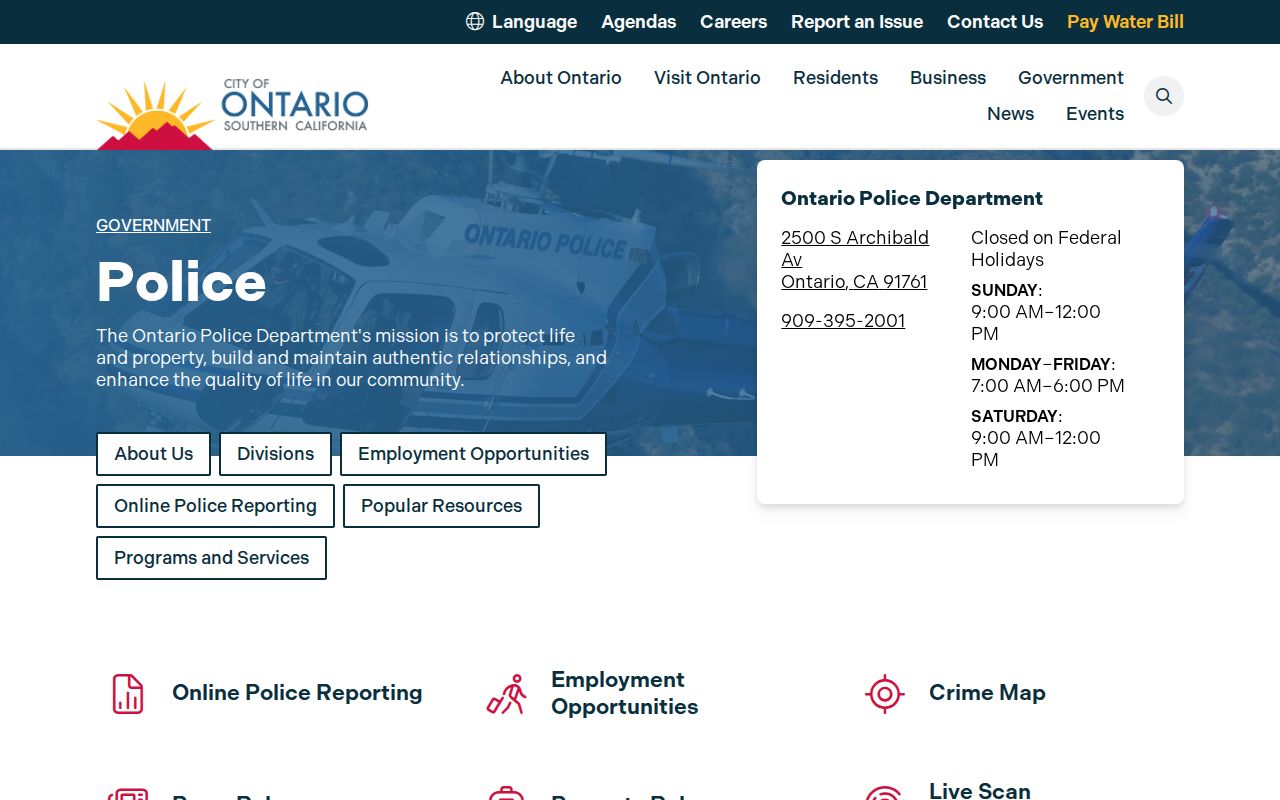
The Ontario Police Department's official page is the department's front door online. It is not a daily booking feed. That means the practical route is a fallback chain. Check county custody if the person may have been accepted into the Sheriff system. Go to the Records Bureau or the city's GovQA portal for an Ontario police report. Use the Superior Court for a filed case. Slower than a blotter, yes. But each question lands with the office that actually holds the answer.
Finding Someone Arrested in Ontario
Search each system in turn. One empty result means little. An arrest can sit in a different database. Ontario lookups work best that way.
- Identify the arresting agency and event date from available paperwork.
- Search the Sheriff Inmate Locator by full name, adding DOB when known, or use the 10-digit booking number.
- Review current housing, bail, arrest date, arresting agency, charges, and projected release only when those fields are published.
- Use the locator’s out-of-custody view by release date if the person no longer appears in current custody.
- Ask Ontario PD Records for the city report when the summary is not enough, then use the court portal for disposition.
The county locator does not promise a precise posting time. Intake, screening, classification, data entry, or a legal restriction can delay a posting. A restriction can also hide a public match. When a person is not listed, the Sheriff points callers to West Valley Detention Center at (909) 350-2476. Some names may be withheld. The county arrest guide walks through the locator fields and custody distinctions in more detail.
Ontario Arrest Records and GovQA Requests
The Ontario Police Records Bureau keeps an RMS. It holds crime reports, traffic collisions, missing-person entries, court arrest packets, and traffic citations. Most hard-copy reports sit in retention for five years. A few are permanent. The public counter runs Monday through Friday, 7:00 a.m. to 6:00 p.m., with weekend service limited to vehicle releases.
Ontario Police Department Records Bureau
The Ontario Police Department sits at 2500 South Archibald Avenue. Records requests go there in person. Call (909) 395-2001 first. The public counter is open weekdays, 7:00 a.m. to 6:00 p.m.
The official Records Bureau page lists the office's holdings and current fee categories.
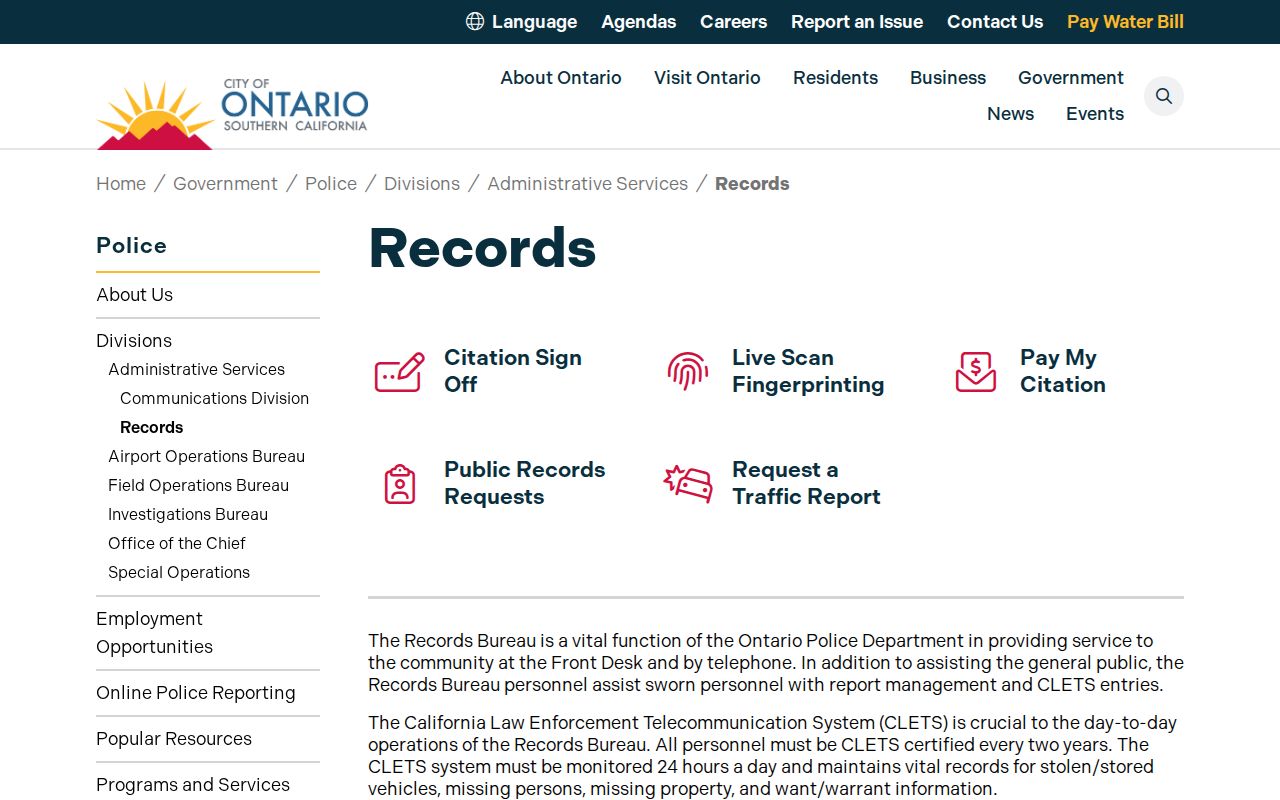
This is the office that holds Ontario police material. It is separate from county jail and court files. Published fees list police reports at $35 each. CAD incidents run $10, and investigation photos cost $62 per hour. Waivers can apply for minors, affected victims, or immediate family. When the online route fits, submit a request through Ontario GovQA. Include the date, location, involved name, report number if known, and the exact record sought. Details up front speed everything up.
What an Ontario Arrest Entry Means
California Government Code § 7923.610 spells out which arrest details may be public. The categories include identity and physical description. Arrest and booking timing, location, and factual circumstances follow. Bail, charges, release information, and any warrant or supervision holds round out the list. Access still bends to safety, investigative, and privacy limits. The city calls its archive a summary. A given PDF may not carry every category a full booking jacket would.
- Arrest time
- When law enforcement reports taking the person into custody.
- Booking time
- When intake into a detention system is recorded, which may be later.
- Charge
- An charge recorded at that stage, subject to amendment or dismissal.
- Disposition
- The later court outcome, found through the court rather than the arrest log.
Juvenile matters stay out of an adult public-log workflow. Protected information does too. A blank field, missing name, or absent report can simply reflect a disclosure limit. Don't fill the gap with details from an unverified repost. The limit is doing its job.
How to Confirm an Ontario Arrest Without a Blotter
No daily Ontario blotter means a different workflow. Start with the arresting agency. Paperwork or a reliable firsthand account usually names it. From there, check the San Bernardino County inmate locator. Look for a possible county-custody match on the arrested person.
City-held records sit elsewhere. Ask Ontario Records directly, or file a focused GovQA request for the specific report. Court searches come last, once a case has had time to be filed. Keep timing in mind throughout. Fresh jail intake can lag while screening, classification, and data entry run their course. Someone released may drop off the current roster. They may still appear in the locator's out-of-custody date view. Log the time of each check, and never read silence from one system as proof. The Arrests Last 24 Hours page covers the countywide same-day limits.
Ontario Mugshots and Court Outcomes
Ontario publishes no booking-photo gallery. Neither does the San Bernardino County locator. The Sheriff's stated policy is that booking photos are generally not released. A reader who wants an image can still ask Ontario PD about a city-held arrest record, or the Sheriff about a county booking record, though exemptions may apply.
California Civil Code § 1798.91.1 targets pay-to-remove schemes. It does not order every image deleted or force an agency to publish one. Commercial arrest pages can rank high in search results, but they are not authoritative. They may lag releases, corrections, sealing, or dismissal. Correct the source record first. Then address stale copies in search indexes. And skip any unverified service promising a guaranteed legal result.
After an Ontario Arrest
After a San Bernardino County booking, custody and case status move on separate tracks. The Sheriff locator handles custody. It shows whether a person remains in the county system or has a recorded release. A filed criminal case lives in the Superior Court public portal, by contrast. Its disposition appears there too.
VINELink sends custody notifications. It works when a participating record exists for the specific person. It is neither an arrest-log archive nor a court docket. State prison is another system entirely. A person sentenced to prison may surface in CDCR CIRIS. That system does not list local jail inmates simply because they were recently arrested. Federal BOP and immigration custody run separate locators too. Match each search to the right custody stage. You avoid reading "not in county jail" as "never arrested" or "case over."
Ontario Police Department Location and Directions
Public Record Search
Sponsored Results